Dan Levenson
SKZ Centimeter Studies Classroom
Opening Saturday, October 10th, 5-8pm
On view through Saturday, November 7th, 2026

Photograph by ofphotostudio
Right now light hurtles through the vacuums of space across vast expanses of the cosmos, moving at speeds nearly unimaginable in relation to our daily lives. However, this velocity is still a quantifiable number; a calculation so reliable that since 1983 the international standard meter has been defined by the speed of light constant, and correspondingly the full metric system unfolds from it. A single meter is calculated as the exact length of the path traveled by light during a time interval of 1/299,792,458 of a second.
In The State Art Academy, Zürich (SKZ)’s now legendary Centimeter Studies Classroom the students were prompted to examine the practicality and poetry of this basic denomination of length. Our thinking can so easily be constrained by the limitations of our narrow frames of reference. The centimeter is an everyday measurement, well suited to our physical size. However, due to its logarithmic qualities, it provides a secret passage between the classroom and the cosmos. Sliding up or down on the meter’s structured powers of ten, the human is confronted with the infinite. Structural congruities in the universe across enormous shifts in scale begin to come into focus. Musings on hard science and facts drift in more existential directions. The humble centimeter in fact raises quite big questions regarding our place in nature, and the limits of our perceptions.
In the Centimeter Studies Classroom the students rigorously composed paintings to seek solutions to given assignments using the titular measurement. The results often feature bands of concentric colors radiating from a central point. The compositions hum with a centrifugal vibration reminiscent of the expanding lightwaves that define the meter.
The SKZ is a fiction invented by Dan Levenson. He makes artworks drawn from this fabricated narrative about a group of Swiss art students in a generic twentieth century past. The paintings, furniture, games, and performances Levenson produces in his Los Angeles studio represent imagined artifacts rescued from the ruins of the school: projects crafted by students, lesson plans, and objects from the scholastic environment. The paintings from this Bauhaus-like institution are executed following the rigid formalist pedagogy of the academy; each is titled after an imaginary student that presumably made it, pulled from a list of over 27,000 names bound in a printed book in Levenson’s studio.
The accompanying sculpted furniture follows similar rules of strict logic in their “form follows function” simplicity of design and standardized proportions. All are made to look old: damaged, stained, paint-spattered, and cracked. Levenson’s exhibitions are like time capsules of classrooms rediscovered after being sealed for decades. Yet they assert that the past is not yet over, threads of old ideas might still be relevant and not fully explored.
These collected pieces become a vehicle for Levenson to raise questions about the germination of new ideas and their spread into the world today, including what it means to be an artist. He speculates about art education’s contradictory task of attempting to teach creativity. Examining an imaginary past could allow us a different model for discussing contemporary issues. The mechanics of who has access to enter our systems of education now, how they are taught, the pathways and processes of becoming a professional from academia to the market, and the ability of art to address and effect larger social and political dynamics.
Dan Levenson has exhibited at The Hammer Museum, Los Angeles; The Philadelphia Art Alliance; James Fuentes, New York; Vielmetter Los Angeles; Municipal Bonds, San Francisco, Oolong Gallery, New York and Rancho Santa Fe; Honor Fraser, Los Angeles; Praz-Delavallade, Paris and Los Angeles; de boer Gallery, Los Angeles; BozoMag, LA; Blue Door, LA and Brooklyn; Eric Firestone Gallery, East Hampton; PARTICIPANT INC, NYC; LAXART, Los Angeles; White Columns, NYC; and Vox Populi, Philadelphia. He is the recipient of a Pollock/Krasner grant and Yaddo and MacDowell Fellowships, among other awards. He has taught performative drawing lessons at the Hammer Museum, American Jewish University, USC’s Roski School of Art, and the Saas-Fee Summer Institute in Berlin, Germany. He received an MFA for the Royal College of Art, London and a BA from Oberlin College, Ohio.
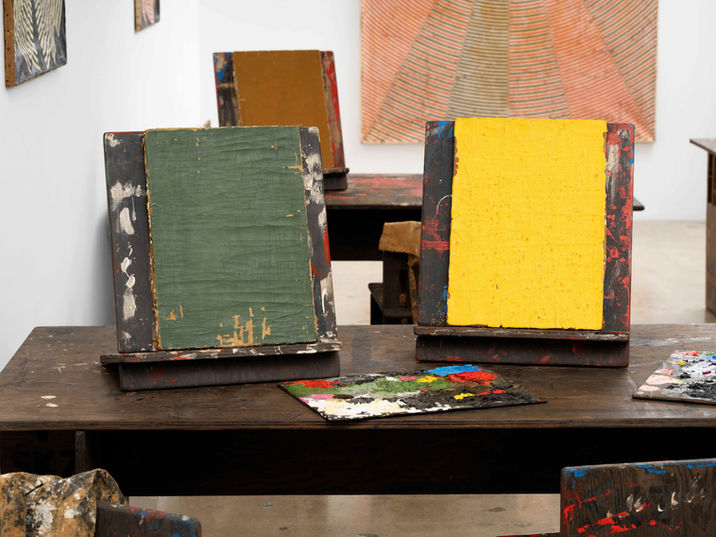
Photograph by ofphotostudio

Photograph by ofphotostudio

Photograph by ofphotostudio
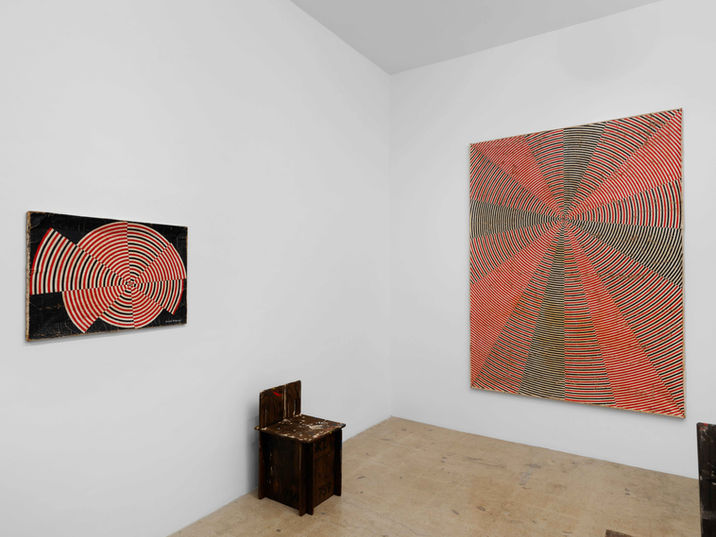
Photograph by ofphotostudio

Photograph by ofphotostudio

Photograph by ofphotostudio

Photograph by ofphotostudio

Photograph by ofphotostudio

Photograph by ofphotostudio

Photograph by ofphotostudio

Photograph by ofphotostudio

Photograph by ofphotostudio

Marius Bänninger, 2026
oil and graphite on linen canvas
33.125 x 23.5 x 0.75 inches

Corinne Fäsi, 2026
oil and graphite on linen canvas
23.5 x 33.125 x 0.75 inches

Reno Diggelmann, 2025/ 2026
oil and graphite on linen canvas
23.5 x 33.125 x 0.75 inches

Arnold Brägenzer, 2025/2026
oil and graphite on linen canvas
23.5 x 33.125 x 0.75 inches

Melania Wirth, 2025
oil and graphite on linen canvas
66.25 x 93.5 x 3 inches

Xavier Urmi, 2026
oil and graphite on linen canvas
23.5 x 33.125 x 0.75 inches

Sonja Hurter, 2025/ 2026
oil and graphite on linen canvas
33.125 x 23.5 x 0.75 inches

Ueli Kaltbrunner, 2026
oil on linen canvas
16.5 x 11.75 x 0.75 inches

Melania Dürsteler, 2026
oil on linen canvas
16.5 x 11.75 x 0.75 inches

Hannes Bräcker, 2026
oil on linen canvas
16.5 x 11.75 x 0.75 inches

Astrid Weiss, 2026
oil on linen canvas
16.5 x 11.75 x 0.75 inches

Katja Wieland, 2017
oil and graphite on linen canvas
16.5 x 11.75 x 0.75 inches

Sonja Leuthert, 2026
oil on linen canvas
16.5 x 11.75 x 0.75 inches

Pia Kloter, 2021/ 2026
oil and graphite on linen canvas
16.5 x 11.75 x 0.75 inches

Egon Lüthi, 2021/ 2026
oil and graphite on linen canvas
16.5 x 11.75 x 0.75 inches

Hans-Ruedi Karrer, 2026
oil and graphite on linen canvas
33.125 x 46.75 x 3 inches

SKZ A3 Format Student Table Easel, Room 185, 2017
painted plywood
16.5 x 16.5 x 16.5

SKZ Student Chair, Room 352, 2017
painted plywood
28.5 x 16.5 x 16.5 inches

SKZ A1 Format Student Painting Apron, Room 28, 2016
oil and enamel on linen canvas
33.125 x 102.25 inches

Karine Gatzmann, 2026
oil on plywood
16.5 x 11.75 x 0.25 in

SKZ A0+A1 Format Student Work Table, Room 6, 2017
painted plywood
29 x 66.25 x 33.125 inches